
Employee Benefits Program in India: How to Design One That Retains Talent
Key Takeaways
- An employee benefits program in India runs on three layers: the statutory floor you are required to fund, the insured layer you choose, and the long‑term liabilities that accrue whether or not you fund them.
- All four labour codes came into force on 21 November 2025, and the unified wage definition applies from that date, raising the base on which gratuity and several other benefits are computed.
- Gratuity on the revised wage base is operative now. The Ministry of Labour and Employment confirmed in FAQs dated 16 March 2026 that gratuity based on the revised definition of wages applies from 21 November 2025.
- ESI sits in an unresolved transition. Section 29 of the Code on Social Security, which governs payment of contributions, has not been brought into operation, and the savings window preserving the previous framework runs to 20 November 2026.
- A new Employees’ Deposit Linked Insurance Scheme was notified on 29 June 2026, carrying the Rs 2.5 lakh to Rs 7 lakh assurance band forward as the standing scheme position rather than a time‑limited extension.
- An employer running a group term life policy richer than EDLI can apply to be exempted from the scheme, a route that now runs through Section 143 of the Code on Social Security.
What is an employee benefits program in India?
An employee benefits program is the set of non‑salary entitlements an employer provides, and in India it sits on three distinct layers that behave very differently. The statutory floor is fixed by law and is not a design choice. The insured layer, covering health, accident and life, is chosen and negotiated. The third layer is the long‑term liabilities, principally gratuity and superannuation, which accrue on the balance sheet from the day an employee joins and become due whether or not anyone has set money aside for them.
Most guidance treats these as a single list, which is why so many programs are designed badly. The three layers carry different obligations, different cost behaviour and different consequences for getting them wrong. Missing the statutory floor is a compliance failure with penalties attached. Getting the insured layer wrong produces a benefit employees do not value and cannot use. Ignoring the third layer produces a liability that surfaces years later, usually all at once, when a cohort of employees crosses five years of service together.
This guide covers those three layers, which is the ground a licensed insurance broker actually works on. It does not cover equity and ESOPs, learning budgets, flexible working policy, meal or mobility benefits, or compensation design. Those matter, and they belong in a total rewards conversation with your HR leadership or a compensation consultant. Treating them as the same problem as statutory compliance and risk transfer is how programs end up expensive and thin at the same time.
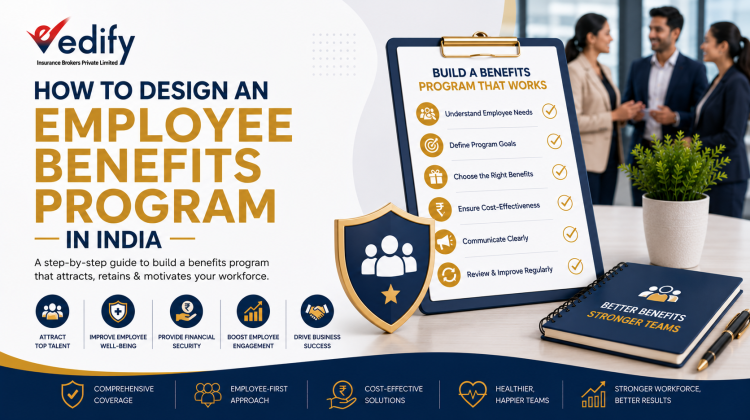
How do you design an employee benefits program?
Six steps, and the order determines how much of the budget survives contact with the statutory layer.
- Map the obligations – Establish which statutory schemes apply at your headcount and wage profile before designing anything discretionary. The statutory floor consumes budget first and is not negotiable, so any voluntary benefit designed before this is designed against a number you do not yet have.
- Fix the budget – Set the total spend and split it across the three layers explicitly. Programs that fail usually allocated everything to the visible layer and left the accruing liabilities unfunded.
- Choose the insured layer – Decide which risks you are transferring to an insurer and which you are carrying. Health, accident and life are separate decisions with separate cost curves, not a single package.
- Fund the liabilities – Decide whether gratuity and superannuation are funded through an approved trust, an insurance‑linked scheme, or carried as a provision. Each has different tax and cash‑flow consequences.
- Communicate it – A benefit employees cannot describe is a cost without a return. Enrolment materials, e‑cards and a named escalation route do more for perceived value than an extra rider.
- Measure utilisation – Track what is actually used. Utilisation data is the only honest input into next year’s design, and it is the evidence you take into a renewal negotiation.
Steps one and two are where programs are won or lost. If you are also mapping the wider Employee Insurance picture across accident, term life and travel, do it here rather than bolting lines on later.
Which employee benefits are legally mandatory in India?
The statutory layer changed materially in the last year, and parts of it are still in transition.
| Benefit | Applies when | Current position |
|---|---|---|
| Provident fund | 20 or more employees | 12% employee and 12% employer, on a wage ceiling of Rs 15,000 notified 29 May 2026. Employer also pays administrative charges of 0.5% of wages, subject to a monthly minimum |
| Employees’ Pension Scheme | With EPF coverage | 8.33% diverted from the employer share, capped at the Rs 15,000 pensionable salary ceiling |
| ESI | 10 or more persons, 20 in some states for shops and commercial establishments | Employees earning up to Rs 21,000 per month, Rs 25,000 for persons with disability. 3.25% employer and 0.75% employee. In transition, see below |
| EDLI | With EPF coverage | Employers pay 0.5% of wages, subject to a monthly cap per employee. Assurance of Rs 2.5 lakh to Rs 7 lakh where the continuous service condition is met |
| Gratuity | 10 or more employees | 15 days’ wages per completed year, capped at Rs 20 lakh. Five years of continuous service, waived on death or disablement. Fixed‑term employees qualify at one year |
| Maternity benefit | 10 or more employees | 26 weeks for the first two children, 12 weeks thereafter. Creche facility required at 50 or more employees |
| Statutory bonus | Per the Code on Wages | Eligibility at wages up to Rs 21,000 per month, between 8.33% and 20% |
Two points deserve attention. ESI is not settled. The Code on Social Security repealed the ESI Act 1948 on 21 November 2025, but Section 29, which governs the actual payment of contributions, has not been brought into operation, and the date on which benefits under the ESIC chapter become available has not been notified. Contributions therefore continue under transitional savings that run to 20 November 2026. What happens at that point has not been resolved by any notification, so treat it as a live compliance question rather than a settled one.
Second, nothing in the labour codes requires an employer to provide private health insurance beyond ESI. Group health remains voluntary for employees above the ESI ceiling.
What should sit in the insured layer?
This is the layer you actually design, and it usually runs to three or four covers.
- Group health. The core benefit, covering hospitalisation for employees and, where the employer chooses, dependants. Everything about it, including what is paid and what is not, is subject to the policy wording, exclusions, sub‑limits and endorsements agreed at inception.
- Group personal accident. Covers accidental death and disablement, typically at a multiple of annual salary. Cheap relative to health cover and frequently omitted.
- Group term life. A lump‑sum death benefit, again usually salary‑linked. Distinct from EDLI, and capable of replacing it.
- Travel cover. Relevant where employees travel for work, and often mispriced as an afterthought.
The EDLI point is worth dwelling on, because almost nobody writes about it accurately. EDLI is compulsory alongside EPF, and the new scheme notified on 29 June 2026 under Section 15(1)(c) of the Code on Social Security carries the enhanced assurance band forward as the standing position. But an employer running a group term life policy that delivers better benefits than EDLI can apply to be exempted from the scheme entirely, a route that previously sat in the EPF Act and now runs through Section 143 of the Code. The application needs roughly six months’ notice ahead of the intended exemption date, and existing exemptions require renewal on a similar timeline. Done properly, employees get a materially larger death benefit and the employer redirects a statutory contribution into a policy it controls.
Deciding how the health line is structured, and on what basis dependents are covered, drives more of the total cost than every other insured line combined. Getting Group Health Insurance right is most of the work.
How do you fund gratuity and superannuation?
Gratuity is a statutory liability that grows every year an employee stays. It is not discretionary, it cannot be waived, and at 10 or more employees it applies whether or not anyone has budgeted for it.
Three funding routes exist. Carrying it as a balance‑sheet provision is the default and the weakest, because provisions are disallowed under Section 40A(7) except in limited circumstances and the cash requirement arrives unpredictably. Establishing an approved gratuity trust makes contributions deductible under Section 36(1)(v) and separates the assets from the business. An insurance‑linked group gratuity scheme achieves the same separation with the fund managed externally and the actuarial valuation handled for you. Section 4A of the Payment of Gratuity Act requires compulsory gratuity insurance or an approved fund for categories of employers notified by the appropriate government, so which route is available to you partly depends on your state.
Superannuation is voluntary and sits alongside gratuity as a retirement benefit funded by employer contributions. Employer contributions to an approved superannuation fund are deductible under Section 36(1)(iv), within limits set by the Income‑tax Rules, and there is an aggregate cap to watch that is discussed below. The detail of funding gratuity liabilities properly deserves its own treatment and we have covered it separately.
What does an employee benefits program cost?
There is no useful published figure. Costs are specific to headcount, age profile, wage structure, industry and the covers chosen. What can be described is what moves the number, and one thing moved it substantially in the last year.
The unified wage definition introduced by the labour codes requires that excluded allowances not exceed half of total remuneration, with the excess added back into wages. Because gratuity, provident fund, bonus, overtime and leave encashment are all computed on wages, raising the wage base raises several liabilities at once. The Ministry of Labour and Employment confirmed in FAQs dated 16 March 2026 that gratuity computed on the revised definition applies from 21 November 2025. Salary structures built around a low base to suppress statutory cost no longer achieve that, and many employers absorbed a cost increase without changing a single benefit.
Two further items shape the total. Employer contributions to provident fund, the National Pension System and an approved superannuation fund are capped in aggregate at Rs 7.5 lakh per employee per year under Section 17(2)(vii) of the Income Tax Act, above which the excess becomes a taxable perquisite in the employee’s hands, along with the annual accretion attributable to it. And on the insured layer, group and employer‑sponsored health policies attract GST at 18%, so budget on the landed cost rather than the base premium. Where the health line dominates the budget, the mechanics of choosing a group health plan are where most of the savings are found.
How do you know the program is working?
Honestly, this is harder to establish than most benefits content admits. There is no credible Indian dataset that isolates the effect of a benefits program on retention, and the percentages that circulate on this question are almost all recycled from overseas consultancy material with no traceable original study behind them. Anyone quoting a precise figure for what benefits do to attrition is guessing.
What can be said is that attrition in India has been falling. Aon’s Annual Salary Increase and Turnover Survey 2025‑26, published on 24 February 2026 and covering more than 1,400 organisations across 45 industries, put attrition at 16.2% in 2025, down from 17.7% in 2024 and 18.7% in 2023. That is context for a benefits budget, not evidence that benefits caused it.
Measure what you can actually observe. Claims utilisation by cover tells you which benefits employees use and which they do not. Enrolment completion tells you whether communication worked. Dependent addition rates show whether the covered unit matches how your workforce actually lives. Escalation volume and resolution time tell you whether the servicing arrangement functions under pressure. Exit interviews will not give you a number, but they will tell you whether benefits come up at all. A benefit nobody uses and nobody can describe is not retaining anyone, whatever it costs.
Conclusion
A benefits program that holds people is rarely the most expensive one. It is the one where the statutory floor is met cleanly, the insured layer covers risks employees actually face, the accruing liabilities are funded before they arrive, and every employee can explain what they have and who to call. The statutory ground has moved considerably in the last year and parts of it are still moving, so anything you read about the labour codes is worth checking against its commencement position rather than its headline.
If you are building or rebuilding a benefits program and want the insured layer structured and the funding routes compared, Contact Edify to talk it through.
FAQs
Q1. Which employee benefits are legally mandatory in India?
The statutory layer covers provident fund and the Employees’ Pension Scheme, ESI where applicable, EDLI alongside EPF, gratuity, maternity benefit, statutory bonus and statutory leave. Each has its own applicability trigger, so a given employer may be covered by some and not others depending on headcount, wages and state. All four labour codes came into force on 21 November 2025, consolidating these into the Code on Wages, the Code on Social Security and the Occupational Safety, Health and Working Conditions Code, though several provisions and most state rules were still being notified through 2026. Private health insurance is not among the mandatory benefits.
Q2. At what headcount do statutory benefits start applying?
Thresholds differ by scheme rather than switching on together. ESI generally applies to 10 or more persons, though several states apply 20 to shops and commercial establishments. Gratuity and maternity benefits apply to 10 or more employees. Provident fund applies at 20 or more. The creche requirement under the maternity provisions starts at 50 or more employees. Because the triggers are staggered, a growing company crosses into new obligations at several different points, which is why mapping applicability is the first design step rather than an afterthought.
Q3. Can an employer replace EDLI with a group term life policy?
Yes, subject to approval. An employer maintaining a group life policy that provides benefits equal to or better than EDLI can apply to be exempted from the scheme, a route that previously sat in the EPF Act and now runs through Section 143 of the Code on Social Security. The application needs to be made in advance, generally around six months before the intended exemption date, and existing exemptions require renewal on a similar timeline. In practice this lets an employer redirect a statutory contribution into a policy it controls while giving employees a larger death benefit. Whether it is worth doing depends on your headcount and wage profile.
Q4. Do the new labour codes require employers to provide health insurance?
No. Nothing in the labour codes obliges an employer to buy private health insurance for employees. ESI provides medical benefits for covered employees earning up to the wage ceiling, and above that ceiling there is no statutory requirement to provide health cover at all. Group health remains a voluntary benefit and a market expectation rather than a legal obligation. Claims that a regulator mandated employer‑provided health insurance generally trace back to a temporary pandemic‑era directive that lapsed and was not replaced.
Q5. How does the 50% wage rule change the cost of a benefits program?
The unified wage definition requires that excluded allowances not exceed half of total remuneration, with any excess added back into wages. Since gratuity, provident fund, statutory bonus, overtime and leave encashment are all computed on wages, a higher wage base raises several liabilities simultaneously. The Ministry of Labour and Employment confirmed in FAQs dated 16 March 2026 that gratuity on the revised definition applies from 21 November 2025. Employers whose salary structures kept basic pay deliberately low to suppress statutory cost have seen that cost rise without changing any benefit. Provident fund is partly insulated where contributions are made only on the notified wage ceiling.