
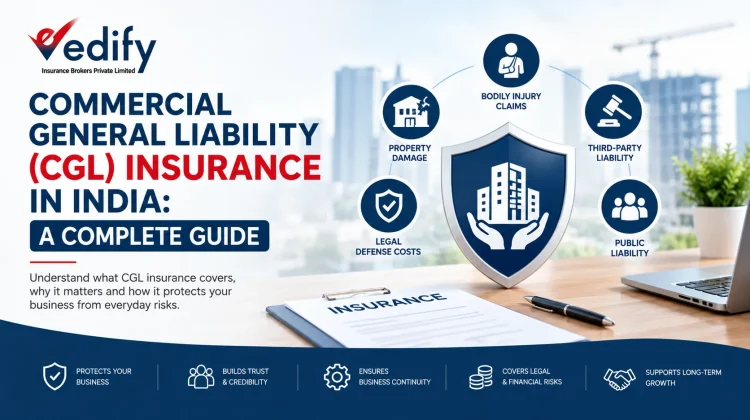
Commercial General Liability (CGL) Insurance in India: A Complete Guide
Key Takeaways
- Commercial general liability insurance responds to third party bodily injury and property damage arising from your premises, operations or products, plus the defence costs that follow, subject to the wording, exclusions and sub‑limits.
- CGL is a contractual cover bought by choice, not a statutory scheme, so it sits alongside rather than inside India’s mandatory liability regimes.
- Under Section 4(1) of the Public Liability Insurance Act, 1991, every owner handling a hazardous substance must take out insurance before handling begins, and that obligation is separate from any CGL policy.
- Employee injury is not a CGL exposure. Employer liability now sits under the Code on Social Security, 2020, which was brought into force on 21 November 2025 and repealed the Employee’s Compensation Act, 1923.
- Product liability claims under Chapter VI of the Consumer Protection Act, 2019 can be brought against a manufacturer, service provider or seller, and a base CGL policy usually treats that exposure through a separate extension.
- Group and commercial insurance policies continue to attract 18% GST, and input tax credit on liability cover depends on Section 17(5) of the CGST Act and your own facts.
Commercial general liability insurance protects a business against claims by third parties who say they suffered injury or property damage because of the company’s premises, operations or products. It pays the compensation the company becomes legally liable to pay, and the cost of defending the allegation, which in India often outlasts and outspends the claim itself. It does not cover your own property, your own employees or your own contractual underperformance, because each belongs to a different policy. Understanding that boundary is most of what a first‑time buyer needs.
What is commercial general liability insurance?
CGL is a third party liability policy. The insuring clause responds when someone outside your business alleges bodily injury or property damage caused by an occurrence connected to your premises or operations, and indemnifies you for damages you become legally liable to pay, together with defence costs. The trigger is a claim from outside, not a loss inside.
Indian CGL wordings are generally written on an occurrence basis, so the policy that responds is the one in force when the injury or damage happened, regardless of when the claim arrives. Professional indemnity and directors and officers covers are written on a claims‑made basis instead, where the policy in force when the claim is first made responds. The distinction matters at renewal, because moving between the two bases can leave a gap for incidents that have occurred but not yet surfaced.
The policy is built from a limit of indemnity, usually expressed as any one accident and in the aggregate for the period, plus a deductible retained on each claim. Around that core sit extensions and endorsements, where most of the real negotiation happens. Two policies with the same headline limit can behave very differently once you read the extensions, the jurisdiction clause and the exclusions.
What does a CGL policy typically cover?
Coverage varies by insurer and wording, so treat this as the common shape rather than a guarantee.
- Third party injury to visitors, customers, contractors or the public arising from your premises or operations.
- Third party property damage caused by your business activities, including premises you occupy where the wording extends to it.
- Defence costs for investigating, defending and settling covered allegations, which may sit inside or outside the limit.
- Contractual liability assumed under an insured contract, where the policy specifically extends to it.
- Sudden pollution from an identifiable incident, with gradual pollution excluded.
Each is subject to the sub‑limits and conditions in the wording actually issued. Ask for the full wording before inception rather than relying on a quotation summary.
What does CGL not cover?
Exclusions decide more claims than the insuring clause does. The pattern below is standard in the Indian market, and each excluded exposure has a home elsewhere in a properly built programme.
| Excluded under CGL | Where the exposure belongs |
|---|---|
| Injury to your own employees | Employer liability under the Code on Social Security, 2020 |
| Damage to your own property, plant or stock | Property, factory or office insurance |
| Financial loss from faulty professional advice | Professional indemnity or errors and omissions |
| Wrongful acts by directors and officers | Directors and officers liability |
| Data breach, privacy and network liability | Cyber liability |
| Recall costs for a defective product | Product recall insurance |
| Gradual pollution and contamination | Specialist environmental liability |
| Deliberate acts, fines and contractual penalties | Generally uninsurable |
Read that as a build order rather than a list of shortcomings. CGL is the base layer, and the Liability Insurance range exists because one policy was never intended to carry all of it.
Who needs commercial general liability insurance in India?
Any business whose activities bring third parties into contact with its premises, people or products carries the exposure. That includes manufacturers, warehousing and logistics operators, construction contractors, hospitality and retail businesses, healthcare providers, event organisers and technology firms with client‑facing offices.
Three triggers move CGL from optional to urgent. The first is a contract, because enterprise customers, landlords, principal contractors and tenders increasingly require a named limit and a certificate of insurance before work begins. The second is public footfall, since the moment members of the public enter your premises the frequency of small injury claims rises. The third is physical work at a customer’s site, where your team can damage property you do not own.
Companies buying Commercial General Liability for the first time often do so because a customer contract demanded it. That is a workable reason to start, but the contract limit is a floor set for the counterparty’s protection, not an assessment of your own worst loss.
How does CGL differ from India’s statutory liability regimes?
CGL is bought voluntarily. Several Indian liability exposures are not, and confusing the two is the most expensive mistake a first‑time buyer makes.
The Public Liability Insurance Act, 1991 requires every owner handling a hazardous substance to take out insurance before handling begins and to keep it renewed throughout. The Act defines owner broadly enough to include, for a company, directors, managers and other officers directly in charge of the business. It provides no‑fault relief to victims, and a CGL policy does not discharge that statutory obligation.
Employee injury sits outside CGL entirely. The Code on Social Security, 2020 was brought into force on 21 November 2025 and, by its repeal provision, subsumes the Employee’s Compensation Act, 1923 along with eight other social security enactments. Central and state rules under the Code were still being finalised at the time of writing, so employers should confirm their current position with counsel rather than assume continuity with the old Act.
Product liability is a third distinct regime. Sections 82 to 87 of the Consumer Protection Act, 2019 allow a product liability action against a manufacturer, service provider or seller for harm caused by a defective product, and a manufacturer can be liable even where it proves it was not negligent in making an express warranty. Base CGL wordings address products through a separate extension, so a business selling goods should check that the extension is present and adequately sub‑limited. The comparison between product liability and general liability cover sets out where the two policies divide.
How do underwriters price a CGL programme?
Premium is risk rated, so no honest guide can quote a figure. Underwriters build the rate from turnover and payroll, the industry and specific activities, the territory and jurisdiction where claims could be brought, the limit and deductible chosen, contractual liabilities assumed, products exposure, and the loss history over preceding years.
That list is also the negotiation agenda. A submission documenting safety systems, incident records, contractor management and quality control gives an underwriter something to price down, while a bare form gets priced defensively. Edify Insurance Brokers, a Bengaluru based corporate broking and risk consulting practice founded in 2015 by insurance professionals, works this part of the process across liability, property and transit and specialty lines, matching submissions to the insurers whose appetite fits the risk. The broader picture of commercial liability cover for Indian businesses is a useful companion read once the specification is settled.
Budget for one commercial point. Group and corporate policies continue to attract 18% GST following the September 2025 reforms, which exempted individual life and health policies only. Whether input tax credit is available depends on Section 17(5) of the CGST Act and your own facts, so put that question to your chartered accountant.
Conclusion
Commercial general liability is the foundation of a corporate liability programme rather than the whole of it. It answers third party injury and property damage claims arising from what your business does, and funds the defence when an allegation is contested. It does not answer employee injury, professional error, board decisions, cyber incidents or the statutory duty on handlers of hazardous substances, and each needs to be placed deliberately.
If your business is buying general liability cover for the first time, or a customer contract has set a limit you need to meet, Contact Edify with your turnover, activities, sites and the contractual requirement you are working to.
Frequently Asked Questions
CGL itself is not mandatory. Separate statutory obligations exist, most notably under the Public Liability Insurance Act, 1991, which requires every owner handling a hazardous substance to take out insurance before handling begins. Customer contracts, tenders and lease agreements also frequently make general liability cover a condition of doing business.
Public liability cover in India is often written specifically to meet the Public Liability Insurance Act, 1991, which provides no‑fault relief for accidents involving hazardous substances. CGL is a broader contractual policy covering third party injury and property damage from premises, operations and, by extension, products. A business handling hazardous substances may need both.
No. Employee injury is an employer liability exposure and falls outside CGL wordings. That liability now sits under the Code on Social Security, 2020, which came into force on 21 November 2025 and subsumed the Employee’s Compensation Act, 1923.
Only where the wording includes a products or completed operations extension. Actions under Sections 82 to 87 of the Consumer Protection Act, 2019 can be brought against manufacturers, service providers and sellers, so any business placing goods in the market should confirm the extension exists and check its sub‑limit.
There is no standard answer. The limit should reflect your worst realistic third party loss, the jurisdictions where claims could be brought and what your contracts require. Where a contract sets a figure, treat it as a minimum rather than a recommendation.
Corporate and commercial insurance policies continue to attract 18% GST. The exemption notified with effect from 22 September 2025 applies to individual life and health policies, not to business cover. Input tax credit availability depends on Section 17(5) of the CGST Act and your own circumstances.