
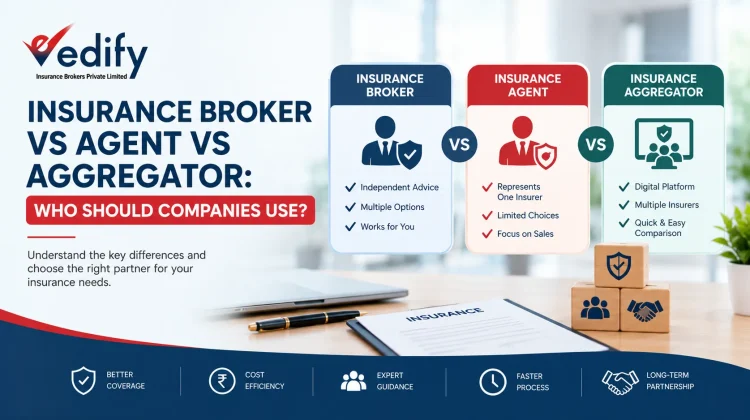
Insurance Broker vs Agent vs Aggregator: Who Should Companies Use?
Key Takeaways
- Most companies buying group or commercial cover are better served by a licensed insurance broker, because a broker is legally bound to act in the client’s interest while an agent is appointed by, and represents, the insurer.
- Under the IRDAI (Appointment of Insurance Agents) Regulations, 2016, an individual agent cannot hold agency appointments with more than one life insurer, one general insurer, one health insurer and one of each mono‑line insurer.
- A corporate agent may tie up with up to three insurers in each of the life, general and health categories, following the 2022 amendment to the IRDAI (Registration of Corporate Agents) Regulations, 2015.
- A web aggregator, under the IRDAI (Insurance Web Aggregators) Regulations, 2017, maintains a website for price comparison and product information across insurers, which suits retail products rather than negotiated corporate programmes.
- Every direct broker must hold professional indemnity cover of two times its annual remuneration subject to a minimum of one crore rupees, under Regulation 24 read with Schedule II Form S of the IRDAI (Insurance Brokers) Regulations, 2018.
- A single policy cannot carry both broker remuneration and agency commission, so the channel chosen at placement is the channel that services the policy for the year.
What is the difference between an insurance broker, an agent and a web aggregator?
An insurance broker is an entity registered under the IRDAI (Insurance Brokers) Regulations, 2018 as a direct, reinsurance or composite broker. The regulations describe a direct broker’s functions in advisory rather than transactional terms: obtaining detailed information about the client’s business and risk management philosophy, familiarising itself with the underwriting information so it can be explained to insurers, advising on appropriate cover and terms, submitting quotations for the client’s consideration, and assisting in the negotiation of claims. An insurance agent is appointed by an insurer to solicit and procure that insurer’s business, so the agent’s product range is bounded by who has appointed them. The 2016 regulations define a composite insurance agent as an individual appointed by two or more insurers on the condition that they shall not act for more than one life insurer, one general insurer, one health insurer and one of each mono‑line insurer. A corporate agent, typically a bank or distribution company, operates under a separate 2015 regulation and, since the 2022 amendment, may hold up to three tie‑ups per category. A web aggregator is described by IRDAI as an intermediary maintaining a website that lets prospects compare prices and view product information across insurers, under regulations effective 13 April 2017. The model is built for products that can be displayed, filtered and bought without underwriting negotiation. That describes most retail motor, travel and individual health business, and almost no corporate programme.Who does each channel legally represent?
The answer sits in the regulations rather than in market convention. Schedule I Form H, the code of conduct every broker must follow, opens by requiring that every insurance broker shall discharge their functions in the interest of the clients or policyholders. The same code requires a broker to ensure the client understands on whose behalf it is acting, and to obtain a written mandate from the client to represent the client to the insurer. An agent has no equivalent client mandate, because the appointment belongs to the insurer. That is not a criticism of agents, who are regulated, examined and often highly capable. It is a structural fact about where the duty sits. When a group health renewal returns with a heavier loading than last year, an agent’s ability to challenge it is bounded by the insurer that appointed them, while a broker holding your mandate can take the same submission to the wider market. The practical test is short. Ask which entity appointed the person in front of you, how many insurers they can approach, and whether they will give you a written mandate.How does each channel get paid?
Distribution remuneration changed on 1 April 2023, when the IRDAI (Payment of Commission) Regulations, 2023 replaced product‑wise commission caps with an approach tying total commission to each insurer’s expenses of management limits under a board‑approved policy. There is no longer a single published percentage to look up for a given product. Two rules matter more to a corporate buyer than the percentage does. Under Regulation 26, no remuneration can be paid where agency commission is payable, and no agency commission where remuneration is payable, so a policy travels through one channel rather than two. A broker may also charge a client fee for risk management services under Regulation 27, but only for commercial risks, only on written confirmation from the client, and not in addition to remuneration for the same service. At renewal, ask which basis applies to your programme and get the answer in writing before inception.What can a broker do that an agent or an aggregator cannot?
Registration as a broker carries obligations that operate, from the client’s side, as protections. A direct broker must hold minimum paid up capital of seventy five lakh rupees under Regulation 19, keep net worth above fifty lakh rupees under Regulation 22, and maintain a ten lakh rupee bank deposit under Regulation 23. Regulation 24 then requires professional indemnity cover throughout registration, set by Schedule II Form S at two times annual remuneration, subject to a minimum of one crore rupees for a direct broker. If a broker’s advice on a wording is wrong and your company suffers a loss, a regulated indemnity stands behind that advice. The code of conduct adds duties an interface cannot replicate. A broker must explain why a policy is proposed and compare price, cover or service where there is a choice, ensure the policy suits the client’s needs, explain the procedure to follow after a loss, and disclose all material facts within its knowledge to give a fair presentation of the risk. That last duty decides contested claims. A comparison screen cannot present a factory’s fire risk to an underwriter. Edify Insurance Brokers works in this space, as a Bengaluru based corporate broking and risk consulting practice founded in 2015 by insurance professionals, structuring programmes across Employee Insurance, property and transit, liability and specialty lines, with an HR dashboard and employee app holding policy, claims and document access in one place.Which channel should your company use?
Match the channel to the complexity of the risk and to how much the wording matters.- Broker suits negotiated corporate programmes: group health, group term life, group personal accident, liability, property and marine, and any cover a customer contract or lender requires you to hold.
- Agent suits a single, standardised policy where you already know the insurer you want and nothing is being customised.
- Aggregator suits retail purchases by individuals and quick price discovery on standardised products.
How do you check that an intermediary is properly licensed?
Verify the category before you weigh the pitch. IRDAI publishes lists of registered brokers, corporate agents and web aggregators, and a registration certificate states its category and validity. Ask for the registration number and category, ask who the Principal Officer is, ask for confirmation that the professional indemnity policy is in force, and ask how a complaint escalates to the insurer’s grievance function. A firm that answers all four without hesitation has thought about the parts of the relationship that only matter when something goes wrong, and the About Edify page sets out the leadership behind that work.Conclusion
Choosing between a broker, an agent and an aggregator is not a preference. It decides who owes you a duty, how many markets you see, and who is on the hook if the advice is wrong. For individual retail cover, an aggregator or an agent is often adequate. For a group or commercial programme, the broking mandate exists because someone needs to be on your side of the table. If your company is buying business insurance for the first time and wants this decision settled before specification work starts, Contact Edify with your headcount, sector and the covers you are being asked to hold.Frequently Asked Questions
Q1. What is the main difference between an insurance broker and an insurance agent in India?A broker is registered by IRDAI in its own right, takes a written mandate from the client, and follows a code of conduct requiring it to act in the client’s interest. An agent is appointed by an insurer and represents that insurer. The distinction determines whose interest the intermediary serves and how many insurers it can approach.
Q2. How many insurers can an insurance agent represent?Under the IRDAI (Appointment of Insurance Agents) Regulations, 2016, an individual agent may not act for more than one life insurer, one general insurer, one health insurer and one of each mono‑line insurer. A corporate agent may hold up to three tie‑ups in each category following the 2022 amendment.
Q3. Do companies pay extra to use an insurance broker?Broker remuneration is generally paid by the insurer out of the premium under the IRDAI (Payment of Commission) Regulations, 2023 rather than charged separately. A broker may charge a fee for risk management services on commercial risks with written client confirmation, but cannot take both remuneration and a fee for the same service.
Q4. Can a company buy group health insurance through a web aggregator?Aggregators are built for price comparison across standardised retail products. Group health is underwritten on headcount, age mix, claims experience and chosen sub‑limits, and terms are negotiated rather than displayed, so a comparison screen rarely reflects what a company is actually offered.
Q5. Is professional indemnity insurance mandatory for insurance brokers in India?Yes. Regulation 24 of the IRDAI (Insurance Brokers) Regulations, 2018 requires every broker to maintain professional indemnity cover throughout its registration. Schedule II Form S sets a direct broker’s limit at two times annual remuneration, subject to a minimum of one crore rupees.
Q6. Can the same policy be placed through both a broker and an agent?No. Regulation 26 states that no remuneration can be paid where agency commission is payable, and no agency commission where remuneration is payable. One channel is recorded on the policy and services it for the policy year.
Publishing pack
Source register
Every statutory figure, date and regulation below was verified against a live source on 9 September 2026. Nothing in the post is written from memory.| Claim used in the post | Source | Where verified |
|---|---|---|
| Broker acts in the client’s interest; must ensure client understands on whose behalf it acts; written mandate to represent the client | IRDAI (Insurance Brokers) Regulations, 2018, Schedule I Form H, Code of Conduct, paras 1 and 2(c) and 2(h) | irdai.gov.in / gazette text of the 2018 Regulations |
| Functions of a direct broker (advice, market knowledge, submitting quotations, assisting claims negotiation) | IRDAI (Insurance Brokers) Regulations, 2018, Schedule I, para 1 | Gazette text of the 2018 Regulations |
| Direct broker minimum paid up capital seventy five lakh rupees | IRDAI (Insurance Brokers) Regulations, 2018, Regulation 19(1) | Gazette text of the 2018 Regulations |
| Net worth floor of fifty lakh rupees for a direct broker | IRDAI (Insurance Brokers) Regulations, 2018, Regulation 22(1)(i) | Gazette text of the 2018 Regulations |
| Deposit of ten lakh rupees with a scheduled bank | IRDAI (Insurance Brokers) Regulations, 2018, Regulation 23(1)(i) | Gazette text of the 2018 Regulations |
| Professional indemnity mandatory; two times annual remuneration, minimum one crore rupees for a direct broker | IRDAI (Insurance Brokers) Regulations, 2018, Regulation 24 and Schedule II Form S, para 3(a) | Gazette text of the 2018 Regulations |
| No remuneration where agency commission is payable, and vice versa | IRDAI (Insurance Brokers) Regulations, 2018, Regulation 26(1)(a), Explanation | Gazette text of the 2018 Regulations |
| Broker may charge a client fee for risk management services on commercial risks with written confirmation | IRDAI (Insurance Brokers) Regulations, 2018, Regulation 27 | Gazette text of the 2018 Regulations |
| Individual agent limited to one life, one general, one health and one of each mono‑line insurer | IRDAI (Appointment of Insurance Agents) Regulations, 2016, Regulation 2(6) and Regulation 3(3) | Official PDF of the 2016 Regulations (licindia.in mirror of the IRDAI text) |
| Corporate agent may tie up with up to three insurers per category (nine in total) | 2022 amendment to the IRDAI (Registration of Corporate Agents) Regulations, 2015 | irdai.gov.in corporate agents page and published legal commentary |
| Web aggregator defined as an intermediary maintaining a website for price comparison and product information across insurers; regulations effective 13 April 2017 | IRDAI (Insurance Web Aggregators) Regulations, 2017 | irdai.gov.in/intermediaries/web-aggregators |
| Product‑wise commission caps replaced by expenses of management linkage from 1 April 2023 | IRDAI (Payment of Commission) Regulations, 2023 | irdai.gov.in and published legal commentary |
| Individual life and health premiums exempt from GST from 22 September 2025; group and corporate policies remain at 18% | Notification No. 16/2025 Central Tax (Rate) dated 17 September 2025, following the 56th GST Council meeting of 3 September 2025 | financialservices.gov.in exemption notice |
| Input tax credit on health and life cover blocked except where obligatory under a law in force | Section 17(5)(b), CGST Act, 2017, and its proviso | CGST Act text and published tax commentary |